


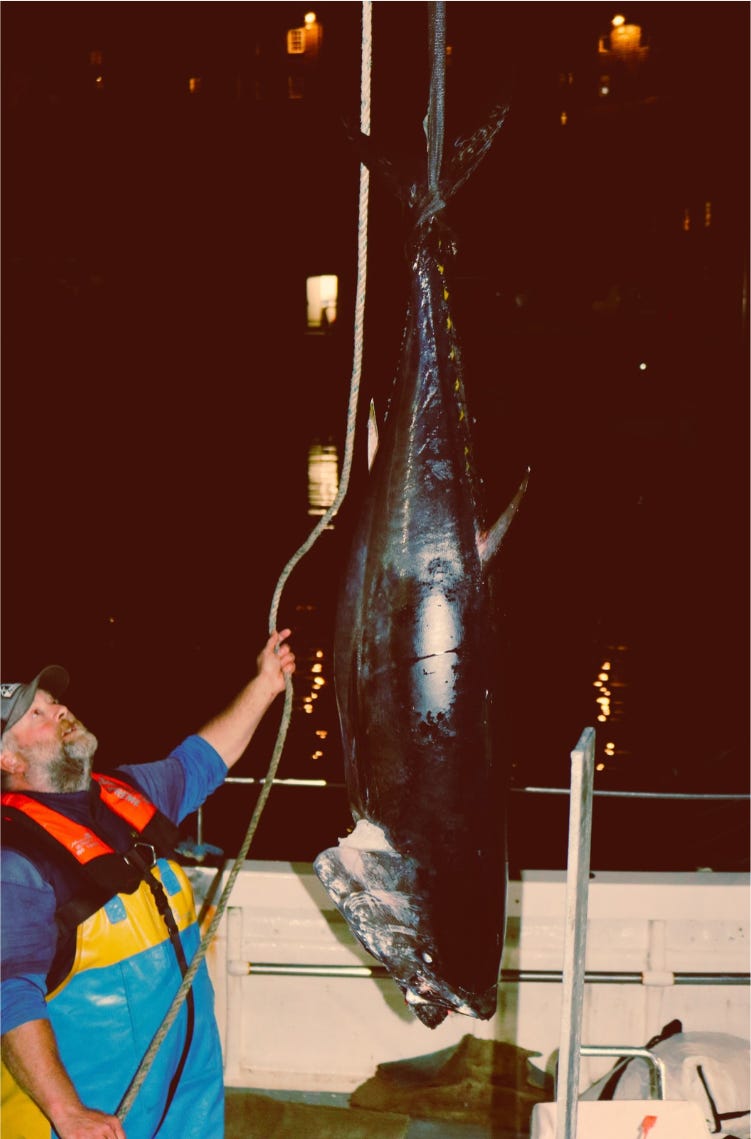
I’ve just written an article for Wicked Leeks about the return of the majestic Bluefin tuna to UK waters as tale of human capacity to take a majestic species to the brink of extinction and the power of nature to revive when we give it room to do so. How this story ends is still yet to be determined. But, how this story started to attract my interest, is one worth sharing…
At London’s oldest conveyor belt sushi restaurant, Moshi Moshi, a celebratory seven-course Bluefin tuna tasting menu will be held next month, featuring maguro (lean tuna) and toro (fatty belly) sashimi, alongside smoky tsukune (grilled tuna meatballs). Despite Bluefin being a sushi highlight, it will be only the fifth time it will have appeared on Moshi Moshi’s menu in 28 years.
“To have it back on our menu is amazing but to have it coming from British waters is even better,” the restaurant’s founder, Caroline Bennett, tells me.
Bennett opened Moshi Moshi in Liverpool Street, in 1994. She had been living in Japan and was back in the UK, working for a bank in the City.
She explains: “In many ways, one of the reasons I started the restaurant was because I just dreamt of Bluefin tuna. That creaminess of a fish is just so rare and, growing up in Britain, it’s just not what we knew about fish. The culinary experience was so different.”
Bennett did some ‘fag-packet’ maths and concluded she would need just 5% of the Japanese bankers working in the City to eat there once a week to make it a success. It was packed every day.
Initially, Moshi Moshi served Bluefin tuna all year round, flying it in from Australia and Japan to meet demand. Then Bluefin started to become harder to source. Bennett recalls walking into the restaurant late summer in 1999 and saying to head chef, Hong: “Call this a Japanese restaurant? We haven’t got any Bluefin on the menu.”
Difficult as it is to remember a time before the internet made information instantly available in the palm of our hands, Bennett started making some calls, including to WWF, and was eventually put in touch with renowned environmentalist Dr. Carl Safina from Monterey Bay Aquarium in the USA.
“I phoned him and said: ‘Carl, I run a restaurant and we’re having real problems getting Bluefin tuna. I’m wondering if you can recommend a really good supplier for it here in the UK?’
“There was total silence on the other end of the phone, a real pregnant pause, before he replied: ‘Now Caroline, you wouldn’t put rhinoceros on your menu, would you?’
Bennett shakes her head at the memory.
“I still did not get it,” she says. “I replied: ‘Of course not, we serve sushi’.”
“It feels silly to say this now but it just hadn’t occurred to me that there was a responsibility as a restaurateur to the environment. That there might not be enough of them in the ocean was completely off my radar,” she admits.
Dr Safina brought Bennett up to speed about how endangered Bluefin tuna were, and she decided to move Bluefin permanently from the menu, dedicating a page on her menu to explaining why. This decision lost her a lot of customers who expected to eat Bluefin.
But, it also led her on a 20-year-journey of trying to source fish as sustainably as possible, working with organisations such as Slow Food and Exeter University and eventually setting up Sole of Discretion to support small boat fishers in Plymouth, which has just been shortlisted as ‘Best Food Innovator’ in this year’s BBC Food & Farming awards. Bennet campaigns for environmental and marine preservation and is recognised in The Independent’s Climate 100 List for her pioneering work in making fish fully traceable.
That Bluefin tuna is now (occasionally) back on the Moshi Moshi menu is testament to what can happen when conservation, science, policy and changes in human behaviour align. But, it also raises the important question: what happens when a species we have fought to protect becomes abundant enough to eat again?
The return of the Bluefin to UK waters is a remarkable conservation story. But, it is not the end of the story. The real test of conservation isn’t simply whether we can bring a species back. It’s whether we can resist the same behaviours that brought it to the brink in the first place. There are already indications that we may be repeating some of the mistakes of the past, with fishing and ranching once again putting enormous pressure on the species. I explore that story here.
